
Strange Two Headed Snakes (15 pics)
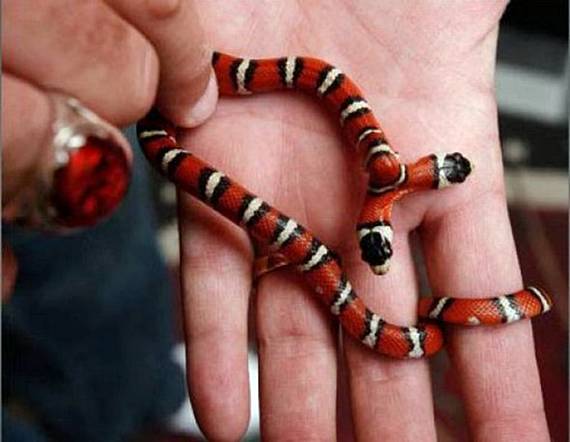
Strange Two Headed Snakes
How many of us believe in the existence of two headed snakes? Well, as with any living creature, they do exist and are a much more common sight than any other two headed animals. While a normal snake gives most people the creeps, the sight of a two headed snake must be tremendously gruesome, but captivating. In truth, two headed snakes are merely conjoined twins, connected to each other via their organs or body parts as with other twins that are connected. This means that a two headed snake could be joined to the other sharing the same organs, but one being a parasitic head.
How many of us believe in the existence of two headed snakes? Well, as with any living creature, they do exist and are a much more common sight than any other two headed animals. While a normal snake gives most people the creeps, the sight of a two headed snake must be tremendously gruesome, but captivating. In truth, two headed snakes are merely conjoined twins, connected to each other via their organs or body parts as with other twins that are connected. This means that a two headed snake could be joined to the other sharing the same organs, but one being a parasitic head.


The birth of Siamese or conjoined twins occur when the embryo splits while developing and growing into identical twins, but for some reason does not complete the process of splitting before they are born. The point at which the embryo stops separating varies with each birth therefore, snakes can be joined at any part of the body. Knowing about the life of a two headed snake has been made possible by studies of captured specimens although it has been found that the life of most two headed snakes is very difficult.


Although the two headed snake has to share the one body, both of the heads are not aware of the existence of the other, therefore, leading individual lives or what they think is individual, so when there is prey to be fed on, only one will actually eat, but it can lead to a sticky situation with them fighting each other for the food. As the two heads are sharing the one body, when one head eats, the two heads feel full as they share the same organs which can lead to confusion with the head that has not eaten, as it fails to understand why it feels full when it has not been fed.


Apart from the problems of feeding, a two headed snake face difficulties in simple tasks like which direction to go. As they both have their own brains, they will each receive separate information, resulting in the dominant one dragging the other in the opposite direction.


The two headed snake can find themselves in dangerous situations when faced with an attack. In this case, the instinct of one head may be to make a quick escape to safety whilst the other may want to stay and fight. This situation could lose precious seconds which could be detrimental to its safety; therefore chances of a long and safe life for a two headed snake in the wild are rare.


In captivity however, a two headed snake may live for twenty years or more with the right head usually being the more dominant in decision making. These decisions can range from which way to slither to what prey to attack. There are some zoos and circuses that have two headed snakes on show with certain museums having preserved specimens.


